
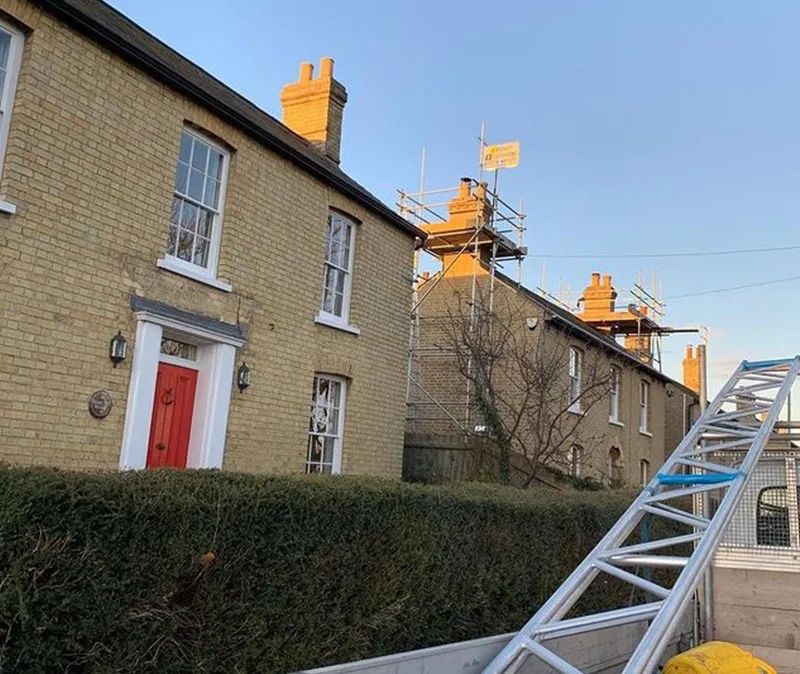
If your scaffold needs to stand in a neighbour’s garden, sit on their drive or reach over their roof, you need their agreement first. In most cases a neighbour can say no. There are two exceptions in England and Wales, and neither one covers every job. This guide explains how the rules work, what to put in writing, and what your options are if the answer is no.
In this article
- The short answer
- Can I put scaffolding on my neighbour’s property?
- When the Party Wall Act gives you a right of access
- When a court can order access
- How to agree scaffold access with your neighbour
- Do I need a scaffolding licence for the pavement or road?
- If you are the neighbour
- What to do if your neighbour says no
- How Priority Scaffolding can help
- Frequently asked questions
The short answer
Yes, a neighbour can usually refuse. A scaffold that stands on, is tied to or overhangs land you do not own needs the owner’s permission, and putting it there without permission is a trespass. There are two exceptions.
- Party wall work. If your building work is covered by the Party Wall etc. Act 1996 and you have served the right notices, the Act gives you a right to go next door to carry out that work, after giving 14 days’ notice.
- Repairs and maintenance. If the work is needed to preserve your property, such as repointing, a roof repair or a chimney repair, you can ask the county court for an access order under the Access to Neighbouring Land Act 1992.
Neither route is quick, and neither is a substitute for asking first. Most scaffold access is agreed between neighbours with a conversation and a short written agreement.
This guide covers England and Wales. Scotland has its own rules. It is general guidance rather than legal advice, so if you are in a dispute, speak to a party wall surveyor or a solicitor.
Can I put scaffolding on my neighbour’s property?
Scaffolding is built from the ground up, so it needs room at the base for the standards (the upright tubes) and boards, and the working platform usually runs a little past the edge of the job. On a detached house with a decent garden that is rarely an issue. On a terrace, a semi or a narrow side return it often is.
You need your neighbour’s agreement if any part of the scaffold will:
- stand on their land, including their garden, path or driveway
- overhang their property, even if it never touches the ground on their side
- rest against or be tied into their wall
- cross onto their roof, which can happen when a chimney stack sits close to the line between two terraced houses
- block their path, a window, a flue or a way out of the house
The overhang point catches people out. Ownership of land normally includes the airspace above it, and guidance from the National Access and Scaffolding Confederation (NASC), the scaffolding industry’s trade body, is that scaffolding over a neighbour’s airspace may be a trespass even when nothing touches their ground.
Our domestic scaffolding team builds on narrow side returns, terraced streets and sloping gardens, and on those houses we look at the boundary on the free site visit. We tell you which parts of the scaffold, if any, will need a neighbour’s agreement, so there are no surprises on the day. Our chimney scaffolding page explains how this works for stacks on terraced roofs.
When the Party Wall Act gives you a right of access
The Party Wall etc. Act 1996 covers three kinds of work: building a new wall on or up to the boundary, work to an existing party wall, and digging foundations close to a neighbouring building. Cutting into a party wall to take the end of a steel beam for a loft conversion is one example of the second. You must serve notice before you start: at least two months for work to an existing party wall, and at least one month for a new boundary wall or an excavation.
Once the Act applies, section 8 lets the building owner, their builders and their surveyors go onto the neighbour’s land during usual working hours to carry out that work. They must give 14 days’ notice, except in an emergency. The government’s explanatory booklet on the Act uses scaffolding as an example of the access involved, and refusing or obstructing entry that the Act allows is an offence.
Two points matter for scaffolding. First, putting up a scaffold does not bring a job under the Act on its own. If your job involves no party wall work, the Act gives you no right to put a scaffold next door. Second, where the Act does apply, the party wall award agreed by the surveyors can set out where the scaffold goes and how the neighbour’s property is protected. If you have an award, give your scaffolder a copy before the job is planned.
When a court can order access
The Access to Neighbouring Land Act 1992 lets you apply to the county court for an order allowing you onto next door’s land to carry out work to your own property. The court can only make an order if the work is reasonably necessary to preserve your property, and it cannot be done, or would be substantially more difficult, without going onto the neighbour’s land.
The Act calls this basic preservation work. It includes maintaining, repairing or renewing any part of a building, which can include jobs such as repointing, re-rendering, roof and gutter repairs and chimney repairs. The court can refuse if the access would cause the neighbour unreasonable hardship or disturbance. Where it grants an order, it can set conditions on how and when the work is done and order compensation for loss or damage.
What the Act does not usually cover is new work. An extension, a loft conversion or a new dormer is an improvement rather than preservation, so the Act is unlikely to help if your neighbour says no. It is also rarely used: the High Court considered it for the first time in 2022, almost 30 years after it came into force. For most people it is a last resort, and a solicitor can tell you whether your job qualifies.
How to agree scaffold access with your neighbour
Most scaffold access is sorted out between neighbours, and it goes best when it is raised early, before the builder or roofer has a start date. A few things make it much easier for a neighbour to say yes.
- Explain the job and the timescale. Say what work is being done, where the scaffold will stand and roughly how long it will be up. People are far more relaxed about two weeks than about an open-ended stay while the builders are in.
- Show them where it goes. After a site visit you will know exactly which parts of the scaffold sit on or over the boundary, so you can show your neighbour the real footprint rather than a guess.
- Put it in writing. NASC recommends recording any access as a written licence agreement, so nobody is unclear about the terms later.
- Take photos first. Photograph their wall, path, garden and roof wherever the scaffold will stand or touch, so any question about damage can be settled on facts.
- Agree how their property will be protected. Boards and base plates under the standards, caps on any tube that touches a wall, and nothing resting against windows, vents or flues.
A written scaffold access agreement should cover these points, which follow the NASC guidance on third party walls:
| Point | What to agree |
|---|---|
| Area | Exactly where on, or over, the neighbour’s land the scaffold will stand |
| Start date and duration | When it goes up and how long it stays |
| Overrun | What happens if the job runs late |
| Access | How and when the scaffolders and trades can come onto their land |
| Protection | Boards, base plates and tube caps, and keeping exits and flues clear |
| Debris and cleaning | How falling debris is prevented and who clears up |
| Payment | Any fee or other request the neighbour has made in return |
| Damage | How damage is reported and who puts it right |
NASC guidance is also clear that arranging access is for the person having the work done, not the scaffolder, and that a scaffolder should not assume a right to go onto neighbouring land. So expect a good scaffolder to check the access is agreed before building over a boundary.
Do I need a scaffolding licence for the pavement or road?
If the scaffold has to stand on a public pavement, verge or road, you need a separate licence from the council that looks after the highway, under section 169 of the Highways Act 1980. This has nothing to do with your neighbour, and in most areas it is the scaffolding company that applies.
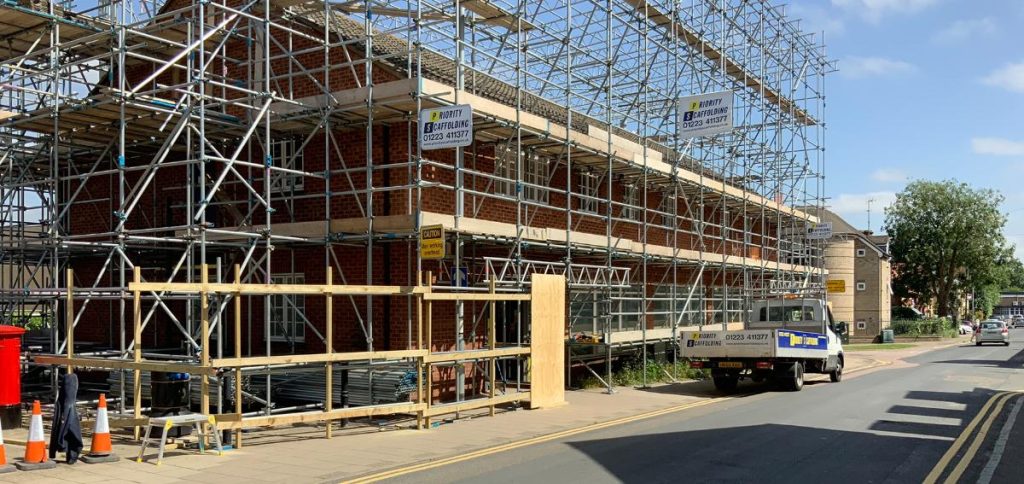
In Cambridgeshire the licence comes from Cambridgeshire County Council. Only registered companies can apply, the application needs a risk assessment, the fee is charged per street for each 30 days, and the council asks for at least 15 working days to process it. So if your house fronts straight onto the pavement, allow three weeks or more before your start date. The pavement licence you may see on Cambridge City Council’s website is for café and pub furniture, not scaffolding.
Outside Cambridgeshire the idea is the same with a different council: Suffolk, Norfolk, Hertfordshire and Essex county councils and Peterborough City Council each run their own scheme. We handle the highway licence as part of the job, so it is one less thing for you to chase. No highway licence is needed if the scaffold stands only on private land, such as your own garden or drive.
If you are the neighbour
If the house next door needs scaffolding on your side, you are entitled to ask questions, set conditions or say no, unless one of the two legal routes above applies. If you are happy to agree, ask for:
- a written agreement covering the points in the table above
- the name of the scaffolding company and confirmation that it carries public liability insurance
- a clear end date, and what happens if the job overruns
- photos of the area taken before the scaffold goes up
If scaffolding goes up on your land without permission, start by talking to your neighbour and their builder, because most problems are fixed quickly that way. If that fails, NASC suggests getting advice from the council, a surveyor or a solicitor before taking any action. If you think a scaffold is unsafe, raise it with your neighbour or the contractor first. If that does not resolve it, or there is immediate danger, contact the council’s building control team, and the Health and Safety Executive if your concerns continue.
What to do if your neighbour says no
A no is not always the end of the job. Depending on the house, there may be another way to get safe access.
- Keep the scaffold on your side. A scaffold can sometimes be designed to stay inside your boundary, for example with a different layout or a cantilevered or bridged section. Anything outside the standard layouts needs a design and calculations, which our scaffold drawings and calculations service covers.
- Split the job. Sometimes only one elevation needs the neighbour’s side, and the rest of the work can go ahead while that part is sorted out.
- Use a smaller access system. For short, low level jobs an access tower with a smaller footprint may fit where a full scaffold will not. See our scaffold tower hire page.
- Check whether a legal route applies. If the work is a repair, or it involves party wall work, the Access to Neighbouring Land Act or the Party Wall Act may help. Take advice before you rely on either.
Tell us what your neighbour has said when you ask for a quote, and we will price access that works within it. You can send us photos and drawings through our contact form or call 01223 411 377.
How Priority Scaffolding can help
Priority Scaffolding is a family run company based on Peverel Road in Cambridge, with 25 years of experience on houses across Cambridgeshire, Suffolk, Norfolk, Hertfordshire and Essex. On every domestic job you get:
- a free site visit and written quote, where we tell you which parts of the scaffold, if any, need a neighbour’s agreement
- the highway licence handled for you where the scaffold stands on a pavement or road
- protective boards and base plates, so gardens, drives and walls are left as we found them
- drawings, calculations and risk assessments supplied for the site file
- CHAS and SafeContractor accreditation, Constructionline Gold membership and £5m public liability cover
Find out more about our scaffolding for extensions, loft conversions, roofs and chimneys, or ask for a free quote. You can also see examples of scaffolding we’ve completed nearby.
Get a free scaffolding quote
Tell us about the job and add any photos or drawings. We will come back with a price and let you know if any part of the scaffold needs a neighbour’s agreement.
Found this useful?
Make Priority Scaffolding a preferred source on Google
Tap below and select us to see more of our guides in Google Top Stories, AI Mode and AI Overviews.
Frequently asked questions
Is there a new scaffolding law about neighbours?
No. The rules on scaffolding and neighbours in England and Wales still come from the Access to Neighbouring Land Act 1992, the Party Wall etc. Act 1996 and the ordinary law of trespass. What has changed is industry guidance. NASC updated its guidance on scaffolding and third party walls in September 2025, and in July 2026 the Building Safety Minister confirmed that temporary access scaffolding is not building work, so it does not normally need Building Control approval.
Do I need to tell my neighbour I am putting up scaffolding?
If the scaffold stays entirely on your land and does not overhang theirs, there is no general legal duty to tell them, although a quick word saves a lot of friction. If any part of it will stand on, touch or overhang their property, you need their agreement before it goes up. If your building work is covered by the Party Wall etc. Act 1996, you also need to serve the notices the Act requires.
Can my neighbour’s scaffolding overhang my property?
Only with your agreement, unless a party wall award or a court order allows it. Ownership of land normally includes the airspace above it, so a scaffold that reaches over your garden or roof may be a trespass even if it never touches the ground on your side.
Can I charge my neighbour for putting scaffolding on my land?
You can ask for a fee as part of a private agreement, and it is a fair thing to raise if the scaffold will be in your garden or on your drive for weeks. If access is ordered by a court under the Access to Neighbouring Land Act 1992, the court can order compensation for loss, damage or substantial inconvenience.
How long can a neighbour’s scaffolding stay on my property?
As long as you agree, which is why the written agreement should give an end date and say what happens if the job overruns. NASC guidance notes that scaffolding left up beyond the agreed period may breach the agreement and could amount to a trespass.
Who arranges access to a neighbour’s land, me or the scaffolding company?
The person having the work done. NASC guidance puts the responsibility for agreeing neighbour access on the customer or main contractor, not the scaffolder. What a scaffolding company can do is tell you exactly what access is needed after a site visit, which makes the conversation with your neighbour much easier.
Does the Party Wall Act cover scaffolding?
Not on its own. The Act covers new walls on the boundary, work to existing party walls and excavation near a neighbour’s foundations. If your job includes that kind of work and you have served notice, the Act’s rights of entry can cover the scaffolding needed to do it, and the party wall award may set out where it goes.
Sources
- Access to Neighbouring Land Act 1992, section 1, legislation.gov.uk
- Party Wall etc. Act 1996, section 8, legislation.gov.uk
- The Party Wall etc. Act 1996: explanatory booklet, GOV.UK
- CG27:25 Third Party Walls and the Scaffolding Contractor, NASC, September 2025
- The Top Five: CG27 Third Party Walls, NASC, February 2026
- Building Safety Act: five key messages for scaffolding contractors, NASC, July 2026
- Highway licences and permits, Cambridgeshire County Council